
Challenges
By their nature, discussions are unpredictable. Even with careful planning and preparation a discussion can sometimes go in directions that you may not have anticipated.
Here you’ll find some best practices for dealing with problems that might arise during a discussion of a difficult issue, as well as some common problem scenarios with some ideas about how to address them.

General Tips
Here are some best practices for what to do when discussions become unproductive.
-
Address the problem head-on. Ignoring problematic behaviour can set a bad precedent or create tension that undermines the discussion.
-
Review and refer to your discussion guidelines as an initial intervention. Try the Co-Created Discussion Guidelines activity to set out your guidelines in advance.
-
Take note of your own reactions, and give yourself a moment to pause and take a breath so that you can continue to guide the discussion effectively.
Sometimes, expressing your feelings of discomfort and sharing how you work through them can make participants more comfortable with their own discomfort.
-
Take a break to give everyone the opportunity to move out of a reactive mindset. Doing something different for a few minutes can break the tension and allow the discussion to move forward productively once it resumes.
-
Switch up the discussion format! For example, try moving from a whole-group discussion into small groups, or vice versa.
-
Pause and ask participants to engage in independent reflection, and return ready to contribute. Aid reflection with a prompt or discussion protocol.
PLANS for Constructive Disagreement
What do you do when:
People can’t get past their differences and struggle to communicate?
You feel like an important part of your identity is under attack?
Discussion turns into a toxic disagreement?
The other person just doesn’t get it?
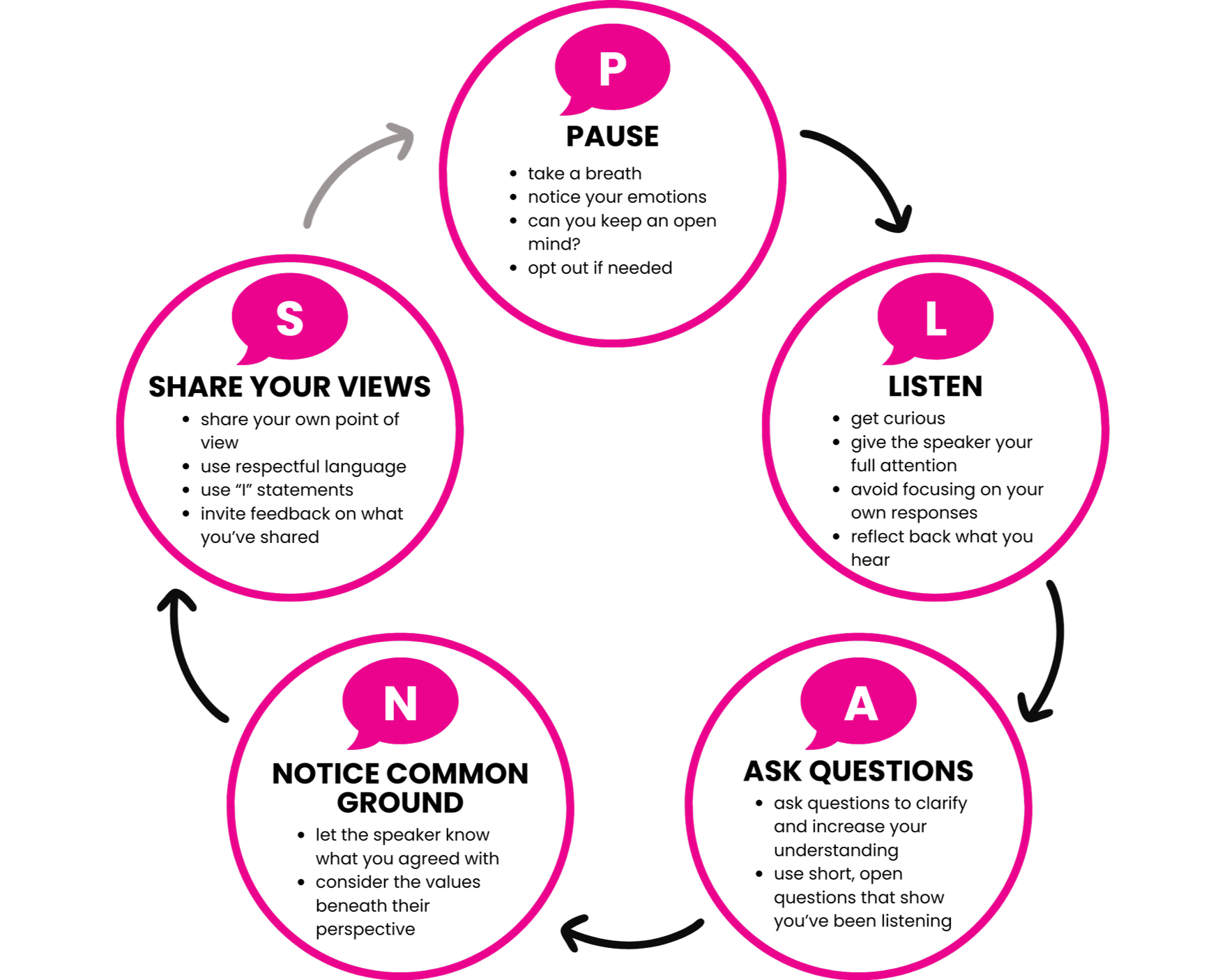
The PLANS for Constructive Disagreement framework encourages active listening and self-expression habits for constructive discussion. It applies both to structured discussions, and unstructured, organic discussions that participants might have with friends or relatives.
Problem Scenarios
Not everyone approaches discussions with the intention to learn from others and contribute productively. Sometimes participants get stuck in their ways, or use discussions as their personal soap box, or just don’t want to participate at all.
We can’t expect to have ideal discussion participants every time. But there are some steps you can take to deal with some common scenarios you might encounter.


What to do when someone is dominating the discussion
-
Unless you have explicit reason to think otherwise, it is best to assume that someone who is dominating the discussion is not trying to do so, and to approach the issue as such.
-
Clarify expectations by introducing discussion norms at the outset to ensure everyone is on the same page, and can be easily held accountable.
-
Plan to prevent this from happening using our discussion protocols which are set up to provide opportunities for equitable participation.
-
In a large group: try saying something like, “let’s hear from someone who hasn’t spoken yet today!”.
Switch it up: switching up the discussion format can help to give others the opportunity to share.
-
If someone is continually dominating the discussion, consider pulling them aside afterwards or during a break and speaking to them about it.

What to do when no one is talking
-
Tell participants what to expect in advance of discussion.
Divide participants into smaller groups to lessen the number of people they’re expected to speak in front of.
-
Remind participants of the role that active discussion plays in achieving your collective aims.
-
Ask participants whether there are any particular barriers to their verbal participation, and provide a way for them to tell you privately or anonymously, through an online form or an exit slip if you are hosting multiple sessions.
-
Try to get more comfortable with silence. Sometimes, it will take a while for people to formulate thoughts that they feel comfortable sharing. That’s okay!

What to do when someone is really stuck in their ways
-
Ensure everyone is on the same page by reviewing the difference between discussion and debate before discussion begins. Reference this distinction and remind them that the goal of discussion is for us to gain a better understanding of one another, not to “win”.
-
Encourage everyone to try on different perspectives. You can try introducing the Value Cards activity, or use one of the discussion protocols.
-
Sometimes, people just aren’t going to change their minds, and the best you can do is acknowledge the disagreement in a way that affirms all perspectives in the room.
-
Remember, there’s a difference between someone being stuck in their ways (yikes!) and someone carefully considering other perspectives and remaining committed to their own view afterwards (totally fine!).

What to do when opinions lack diversity
-
If the goal of your discussion is to gain a better understanding of the issue at hand, then having a diverse range of opinions on the table is important.
Just because one opinion or set of opinions are dominating the discussion, this doesn’t mean everyone is in unanimous agreement! It can be disproportionately taxing to defend a view that doesn’t conform to the status quo, so those who don’t hold the prevailing opinion might just not be saying it.
-
Lead by example and introduce another viewpoint yourself. Try:
“Have you considered…?”
“While this makes sense, someone else might argue… . What do you think?”
-
Encourage the expression of diverse views by using an iceberg activity to get participants to more deeply consider their opinions and why they hold them.
-
Have participants engage in a perspective-taking activity. Check out the Tools and Activities page for options.